Models that connect mechanisms
to material properties.
I study how physical mechanisms govern microstructures and their evolution, and how these changes affect material properties.
Microstructures in motion and beyond.
A material’s properties depend on the phases present, their size, shape and distribution, and the interfaces between them. During processing and service, phases form, grow, dissolve and coarsen, so the microstructure depends on temperature, time, loading and the initial state. I use phase-field models to calculate this evolution, including phase separation, precipitate growth, multivariant microstructures and ferroelectric domains. These models describe moving interfaces with smoothly varying fields, allowing boundaries to join or split without tracking each interface separately.
Phase-field equations and my earlier thesis work
For alloy microstructures, the total free energy contains bulk chemical, interfacial and elastic contributions. Conserved composition fields evolve through Cahn–Hilliard equations; nonconserved structural order parameters evolve through Allen–Cahn equations. Mechanical equilibrium determines the elastic fields produced by lattice misfit.
In my ferroelectrics work, polarization is the field that describes the magnitude and direction of the local electric dipole moment per unit volume. Its evolution follows a time-dependent Ginzburg–Landau equation. The free energy includes contributions from polarization, its spatial variation, elasticity and electric fields. Coupling between polarization and strain, together with mechanical equilibrium and electrostatics, allows us to calculate domain formation and switching under applied electric fields and mechanical constraints.
My master’s thesis examined ternary spinodal decomposition and the effect of relative interfacial energies on the formation and coarsening of three-phase microstructures. The three dimensionless mole fractions satisfy \(c_A+c_B+c_C=1\), so two composition fields are independent. The gradient-energy coefficients determine the energetic cost of composition gradients and influence the relative interfacial energies.
My PhD thesis examined a disordered matrix and three orientational variants of an ordered precipitate. The model uses one conserved composition field and three nonconserved structural order parameters. Each variant has a crystallographically related misfit-strain tensor. I studied how the magnitude and sign of its principal components affect precipitate shape, variant arrangement and coarsening. The model uses homogeneous, isotropic elastic constants; its anisotropy is in the misfit strain.
Doctoral theses I have guided on microstructural evolution
The following examples come from the doctoral research of my PhD students Sandeep, Tushar, Soumya and Pankaj. I jointly supervised Pankaj with Subhradeep Chatterjee. The images and movies show the results; the linked papers explain the models and calculations.
Sandeep Sugathan — phase separation in ternary alloys
A Phase-Field Study of Elastic Stress Effects on Phase Separation in Ternary Alloy Systems.
Sandeep and I studied how relative lattice misfits, interfacial energies and elastic anisotropy affect phase separation, phase arrangement and coarsening in ternary alloys. Related papers: elastic stress effects on ternary phase separation and elastic anisotropy.
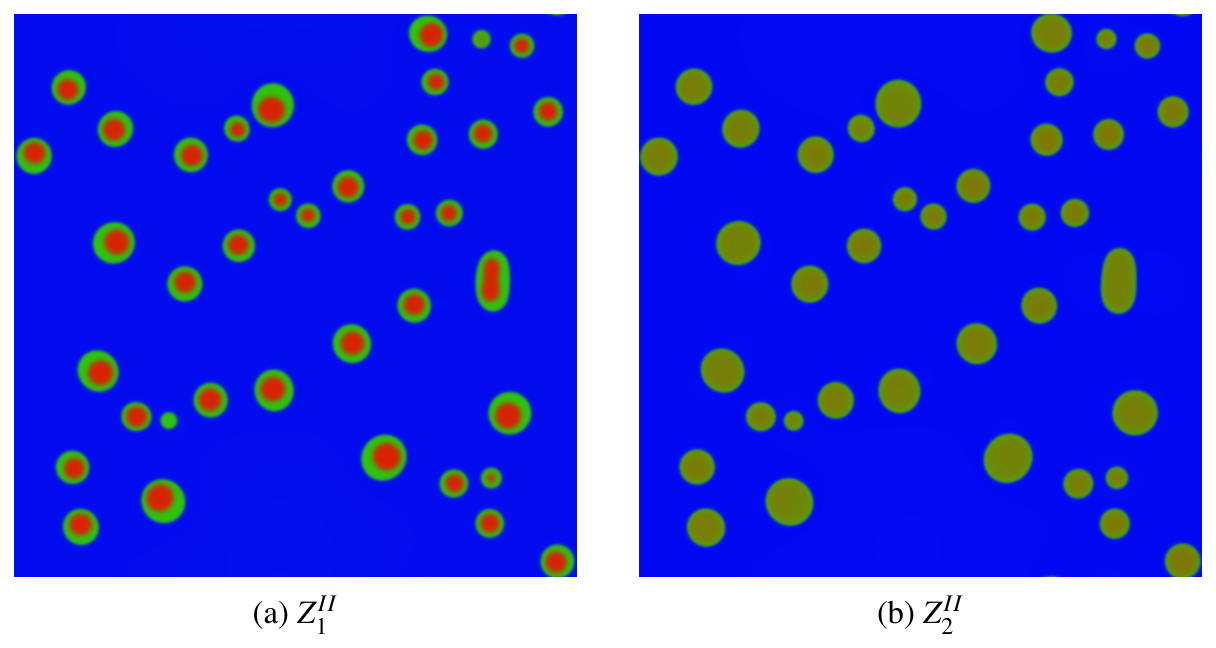
Core-shell precipitate growth
Red shows the γ cores, green shows the β shells, and blue shows the α matrix.
Simulation parameters
Composition is expressed as dimensionless mole fractions: \(c_A+c_B+c_C=1\). The initial matrix has \(c_B=0.10\) and \(c_C=0.09\); the initial nuclei have \(c_B=0.05\) and \(c_C=0.87\).
The component mobilities, which determine transport rates, are \(M_A=M_B=1\) and \(M_C=0.1\), in nondimensional model units. The dimensionless misfit strains relative to the α matrix are \((\epsilon_{\alpha\beta},\epsilon_{\alpha\gamma})=(0.010, 0.010)\).
The Zener anisotropy ratio is \(A_z=1\). It is defined by \(A_z=2C_{44}/(C_{11}-C_{12})\), where \(C_{11},C_{12},C_{44}\) are cubic elastic stiffness constants. \(A_z=1\) gives isotropic elasticity.
Simulation parameters
Composition is expressed as dimensionless mole fractions: \(c_A+c_B+c_C=1\). The initial matrix has \(c_B=0.15\) and \(c_C=0.09\); the initial nuclei have \(c_B=0.05\) and \(c_C=0.87\).
The component mobilities, which determine transport rates, are \(M_A=M_B=1\) and \(M_C=0.1\), in nondimensional model units. The dimensionless misfit strains relative to the α matrix are \((\epsilon_{\alpha\beta},\epsilon_{\alpha\gamma})=(0.010, 0.010)\).
The Zener anisotropy ratio is \(A_z=1\). It is defined by \(A_z=2C_{44}/(C_{11}-C_{12})\), where \(C_{11},C_{12},C_{44}\) are cubic elastic stiffness constants. \(A_z=1\) gives isotropic elasticity.
Simulation parameters
Composition is expressed as dimensionless mole fractions: \(c_A+c_B+c_C=1\). The initial matrix has \(c_B=0.10\) and \(c_C=0.09\); the initial nuclei have \(c_B=0.05\) and \(c_C=0.87\).
The component mobilities, which determine transport rates, are \(M_A=M_B=1\) and \(M_C=1\), in nondimensional model units. The dimensionless misfit strains relative to the α matrix are \((\epsilon_{\alpha\beta},\epsilon_{\alpha\gamma})=(0.006, 0.012)\).
The Zener anisotropy ratio is \(A_z=3\). It is defined by \(A_z=2C_{44}/(C_{11}-C_{12})\), where \(C_{11},C_{12},C_{44}\) are cubic elastic stiffness constants. \(A_z=1\) gives isotropic elasticity.
Tushar Jogi — evolution and deformation in Ni-base superalloys
Computational Modeling and Simulations of Process–Microstructure–Property Relations in Model Ni-base Superalloys.
Tushar and I studied how dislocations move and form networks at precipitate interfaces during high-temperature creep. In this work, Tushar extended the three-dimensional discrete dislocation dynamics code ParaDiS to include precipitates. We examined the effects of applied stress, precipitate spacing, glide and climb. Our dislocation-network paper gives the results. OpenDiS, developed by Wei Cai and the OpenDiS team, now provides an open-source framework in which we can adapt and share our precipitate module. Our later phase-field study examines precipitate splitting in Ni-base superalloys.
Dislocations and creep
Dislocations are line defects in a crystal. Glide moves a dislocation within its slip plane; climb moves it out of that plane through the absorption or emission of point defects. Creep is deformation that develops with time under an applied load.
Atchyut, one of my current PhD students, extended the splitting code to multiple GPUs and processors for very large-scale simulations. He is studying multiparticle splitting, elastic inhomogeneity and directional coarsening (rafting). We will add new results as they become available.
Elastic inhomogeneity and rafting
Elastic inhomogeneity means that the matrix and precipitates have different elastic constants. Rafting is directional coarsening: precipitates develop extended arrangements under the combined effects of elastic stresses and an applied load.
Soumya Bandyopadhyay — ferroelectric domain evolution and switching
A Phase-Field Study of Electromechanical Effects on Domain Evolution and Polarization Switching in Bulk, Thin-film and Multilayer Ferroelectric Perovskite Oxides.
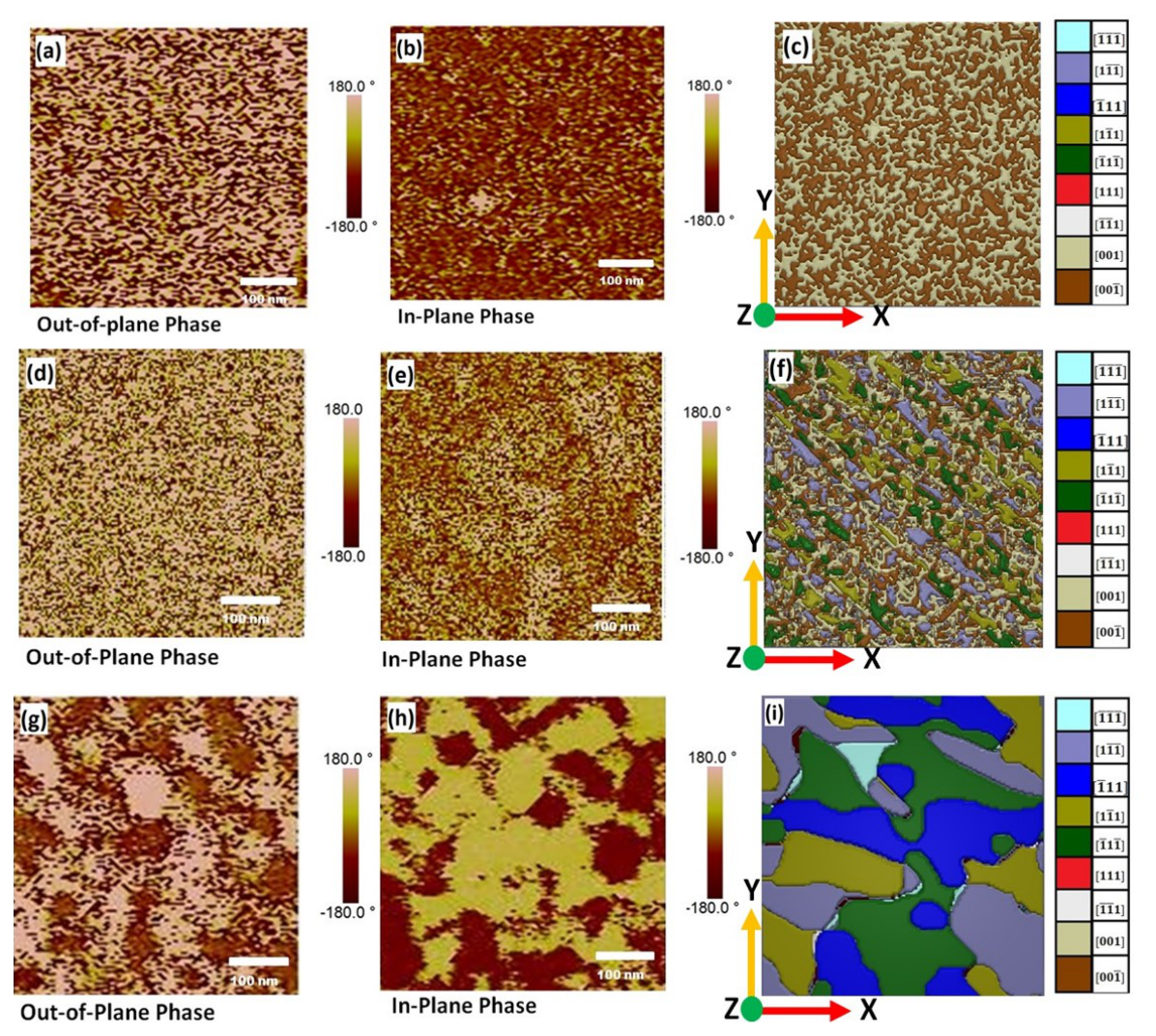
Soumya and I, in collaboration with Ranjith Ramadurai, studied how electrical and mechanical conditions affect ferroelectric domain structures and polarization switching. Ranjith has been a collaborator in my ferroelectrics work. A domain is a region with a particular polarization direction. The models couple polarization, strain and electric fields. Related paper: thermodynamic analysis and phase-field simulations of electrostriction and domain switching.
P. Pankaj — morphology development in bimetallic nanoparticles
Morphology Development in Bimetallic Nanoparticles: A Phase Field Study.
Pankaj, Subhradeep and I studied how phase separation, surface preference and diffusion produce core-shell and Janus morphologies. In a Janus particle, the two phases occupy adjacent regions. We used an embedded phase-field model to describe the particle and its surroundings. Related papers: competition between core-shell and Janus morphologies and surface-directed and bulk spinodal decomposition.
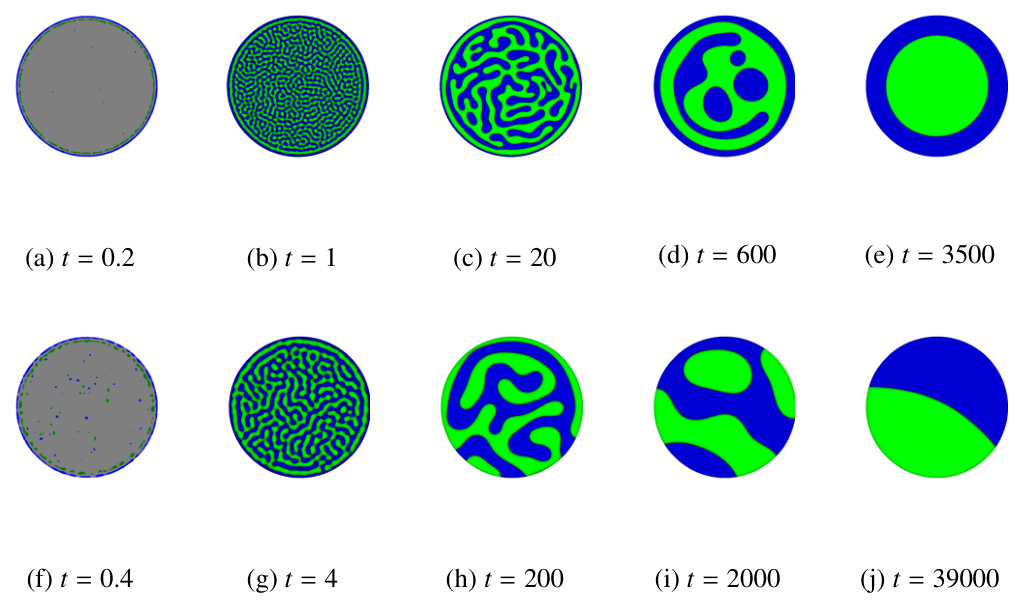
The movies rotate the final Janus structures through 360° to show the internal interface and particle surface. This is a change in viewing direction, not further simulated evolution.
Particle size and surface-energy parameters
The particle diameter is \(d=140\) in dimensionless model units. The dimensionless parameter \(\chi\) controls the composition dependence of surface energy: \(\chi=0\) gives equal surface energies for the two phases, while \(\chi=0.25\) gives different surface energies.
The embedded-model idea
I use a dimensionless auxiliary field \(\phi\) to distinguish a particle from its surroundings. The smooth function \(h(\phi)\) changes from zero outside to one inside; \(1-h(\phi)\) and \(h(\phi)\) weight the exterior and particle free energies. Sandeep and I studied core-shell precipitation with a coupled composition–structural-field model before the later nanoparticle studies with Pankaj. I developed the embedded-particle model and original CPU code; Pankaj developed the GPU implementation from that code. The GitHub repository provides the equations, Julia code and run instructions.
Development of my auxiliary-variable and embedded models
This work builds on my earlier development of auxiliary-variable models. In my PRL work on hierarchical phase-separating structures (2006), I used the composition \(c_A\) as an auxiliary variable in a ternary model. Here, \(c_A\), \(c_B\) and \(c_C\) are dimensionless mole fractions, with \(c_A+c_B+c_C=1\).
In my PCCP work on lithium intercalation in a nanoparticle (2016), I introduced a separate dimensionless field \(\phi\) to describe the particle domain and used it to impose boundary conditions in a spectral smoothed-boundary model.
Before the nanoparticle studies with Pankaj, Sandeep and I developed a coupled composition–structural-field model and studied core-shell precipitation in ternary alloys. The structural field distinguishes the disordered matrix from the ordered precipitates, while composition distinguishes the two precipitate phases. We examined how interfacial energies and lattice misfits affect the formation and stability of core-shell structures. This work appears in Sandeep’s thesis and our MRS Advances paper (2019).
The later fixed-particle implementation differs from the evolving structural field used in the earlier coupled model. The embedded-model explanation gives the equations, and the model history gives the earlier references and the distinctions between implementations.
Theses and related papers
- My M.Sc. (Eng.) thesis: Ternary spinodal decomposition (original PDF). Please note the typographical errors in the \(M_{AB}\) expression and the numerical \(k^2\)/\(k^4\) terms.
- My PhD thesis: Evolution of Multivariant Microstructures with Anisotropic Misfit: A Phase Field Study (PDF). Related paper: Bhattacharyya and Abinandanan, Acta Materialia 57, 646–656 (2009).
- Our ternary phase-separation paper: Sugathan and Bhattacharya, A phase-field study of elastic stress effects on phase separation in ternary alloys, Computational Materials Science 172, 109284 (2020) · Preprint.
- Elastic anisotropy: Sugathan and Bhattacharya, Effect of elastic anisotropy on phase separation in ternary alloys: A phase-field study.
Examples and source codes
My NRCM phase-field workshop examples explain spinodal decomposition and precipitate growth using conserved composition and an evolving structural field. The page includes my original C sources and input files.
- Chemical spinodal decomposition: see how small composition fluctuations grow into domains.
- Binary spinodal decomposition with homogeneous elasticity: change the misfit and elastic constants and see their effect on phase separation.
- Embedded phase-field models: see how a particle field distinguishes the particle from its surroundings and weights their free energies.
Elastic Stress Effects.
I study how lattice misfit, elastic anisotropy and differences in elastic constants affect phase separation and precipitate shape. I also develop Fourier-based methods for calculating stress and elastic energy in heterogeneous materials. The laboratory and derivation pages explain the equations and provide calculations you can explore.
Elastic stress effects: studies, papers and derivations
My work examines elastic stress effects on microstructural evolution, including anisotropic misfit, elastic anisotropy and elastic inhomogeneity. We develop phase-field models and FFT-based microelasticity solvers to study the coupling between evolving microstructures and mechanical fields.
Applications include elastic stress effects on phase separation in ternary alloys, multivariant microstructures with anisotropic misfit, and stress effects on grain boundary migration. Related work connects discrete dislocation dynamics and crystal plasticity with strengthening and deformation in heterogeneous materials.
Questions we investigate
- How do anisotropic misfit and elastic interactions influence microstructural morphology and variant evolution?
- How do elastic anisotropy and inhomogeneity affect phase separation in alloys?
- How can spectral methods resolve mechanical fields in heterogeneous microstructures?
Selected publications behind these questions
- Evolution of multivariant microstructures with anisotropic misfit (Acta Materialia, 2009): how the sign and magnitude of principal misfits select elongated, invariant-line, star, wedge and checkerboard morphologies.
- A phase-field model of stress effect on grain boundary migration (MSMSE, 2011): how applied stress, modulus contrast and grain orientation provide a mechanical driving force for boundary motion.
- A spectral iterative method for the computation of effective properties of elastically inhomogeneous polycrystals and Elastic solutions with arbitrary elastic inhomogeneity and anisotropy (2012): Fourier iterative solvers beyond the homogeneous-modulus approximation.
- A phase-field model for elastically anisotropic polycrystalline binary solid solutions (Philosophical Magazine, 2013): phase separation coupled to crystallographic elastic anisotropy in polycrystals.
- An integrated FFT-based phase-field and crystal-plasticity approach to model recrystallization of three-dimensional polycrystals (CMAME, 2015): coupling evolving microstructure to heterogeneous deformation fields.
- A phase-field study of elastic stress effects on phase separation in ternary alloys and Effect of elastic anisotropy on phase separation in ternary alloys (2019–2020): self- and cross-interactions among phases with different misfits.
- Interfacial dislocation network in precipitation-strengthened alloys during creep (MSMSE, 2021): three-dimensional discrete-dislocation dynamics of interfacial networks.
- Splitting Instability in Superalloys and the related Inconel 740H γ′-coarsening study (2024): precipitate stability, splitting and long-time evolution in Ni-base superalloys.
Elastic stress effects form a continuing research direction across our models, solvers and materials applications. The same physical questions run through our studies of multivariant microstructures, ternary phase separation, coherent precipitate interactions, Ni-base superalloys and ferroic materials.
In Ni-base superalloys, we examine how lattice misfit, applied stress, elastic anisotropy and elastic inhomogeneity influence precipitate morphology, splitting, directional coarsening or rafting, and long-time microstructural stability. Our related Intermetallics study of γ′ coarsening in Inconel 740H connects this broader superalloy program with CALPHAD-informed phase-field modeling and GPU computation.
This thread also continues through our FFT-based homogeneous and inhomogeneous elasticity solvers, current elasto-viscoplastic superalloy work, classroom notebooks, the Elastic Stress Effects Laboratory, and high-performance phase-field development alongside MicroSim.
Elastic energy and driving-force derivations
Starting from mechanical equilibrium, the derivation constructs the Fourier-space elastic-energy kernel and then obtains the variational derivatives that drive composition and structural order-parameter evolution. The formulation begins with Eshelby’s inclusion construction and Mura’s eigenstrain method. The homogeneous elastic-energy kernel then follows Khachaturyan’s Chapter 7 treatment of arbitrary multiphase alloys and coherent-inclusion interactions. Our Communications in Computational Physics paper supplies the separate reference-medium iteration for elastically inhomogeneous systems. My thesis appendices remain available as one detailed multivariant derivation.
Study the Fourier-space kernel and driving-force derivations →PINN Inverse Modeling.
Learn the idea step by step: interactive PINN introduction →
I develop numerical inverse methods using physics-informed neural networks (PINNs) and multiobjective optimization to extract diffusion coefficients and mobility data in multicomponent alloys from experimental diffusion profiles.
This research is carried out in collaboration with Prof. Aloke Paul’s group at the Indian Institute of Science (IISc), Bengaluru. His group leads the experimental diffusion studies and measurements, while my group at IIT Hyderabad develops the PINN and numerical inverse-modeling methods.
Together, we connect experimental evidence with governing transport equations to infer composition-dependent diffusion coefficients and mobility data. Applications include pseudo-binary diffusion couples and multicomponent NiCoFeCr and NiCoFeCrMn alloys.
The inverse problem can be posed as multiobjective optimization: fit the experimental profiles while satisfying transport equations and conditions, and use independent diffusivity data where available.
Explore diffusion and PINN publications →Computational methods and software.
My group develops GPU-accelerated phase-field solvers and parallel numerical methods. The IITH contribution to MicroSim includes CUDA-based modules such as KKS-CuFFT and KKS-FD-CUDA-MPI.
We also investigate machine-learning approaches to accelerate physics-based models of microstructural evolution.
Across research and industry.
My projects include work supported by General Electric, Tata Steel, DMRL, MIDHANI, DST-SERB, the National Supercomputing Mission and ARDB. These span strengthening, steel transformations, superalloy processing, functional oxides and computational materials design.
See selected projects and experience →