MATERIALS SCIENCE · COMPUTATION · ACCELERATED DISCOVERY

Understanding materials
through their
microstructures.

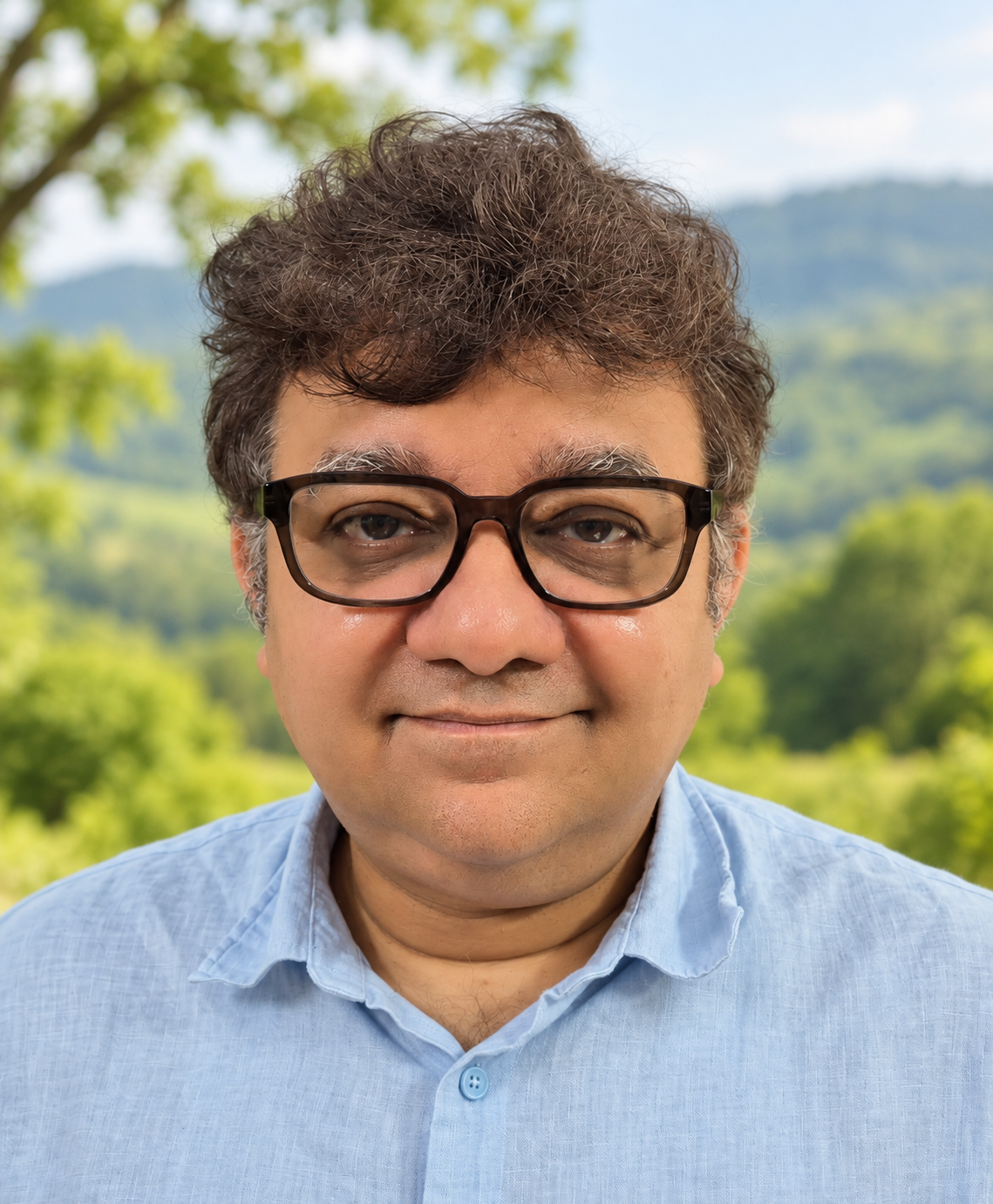
I’m Saswata Bhattacharyya, Professor at IIT Hyderabad. I develop computational models to understand how microstructures evolve and how they shape the properties of materials.

DEPARTMENT OF MATERIALS SCIENCE &
METALLURGICAL ENGINEERING · IIT HYDERABAD
RESEARCH
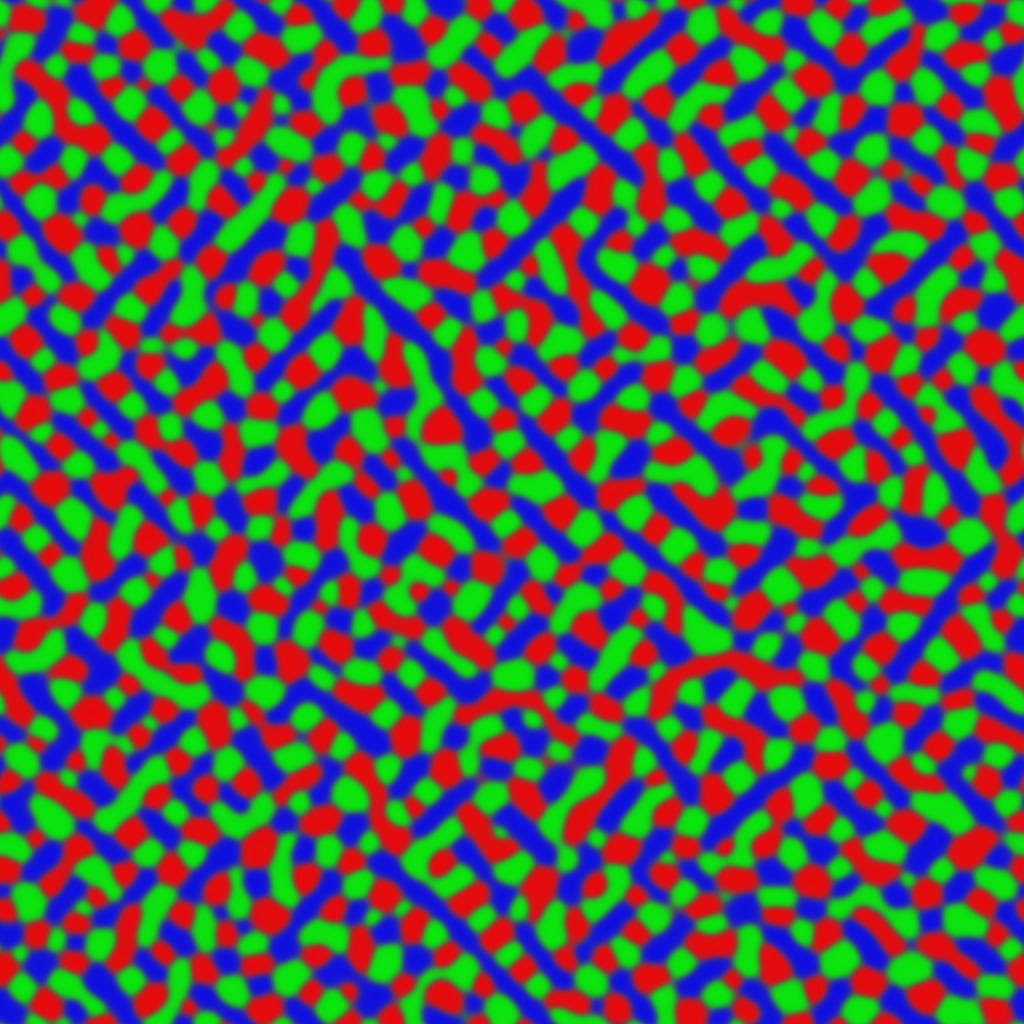
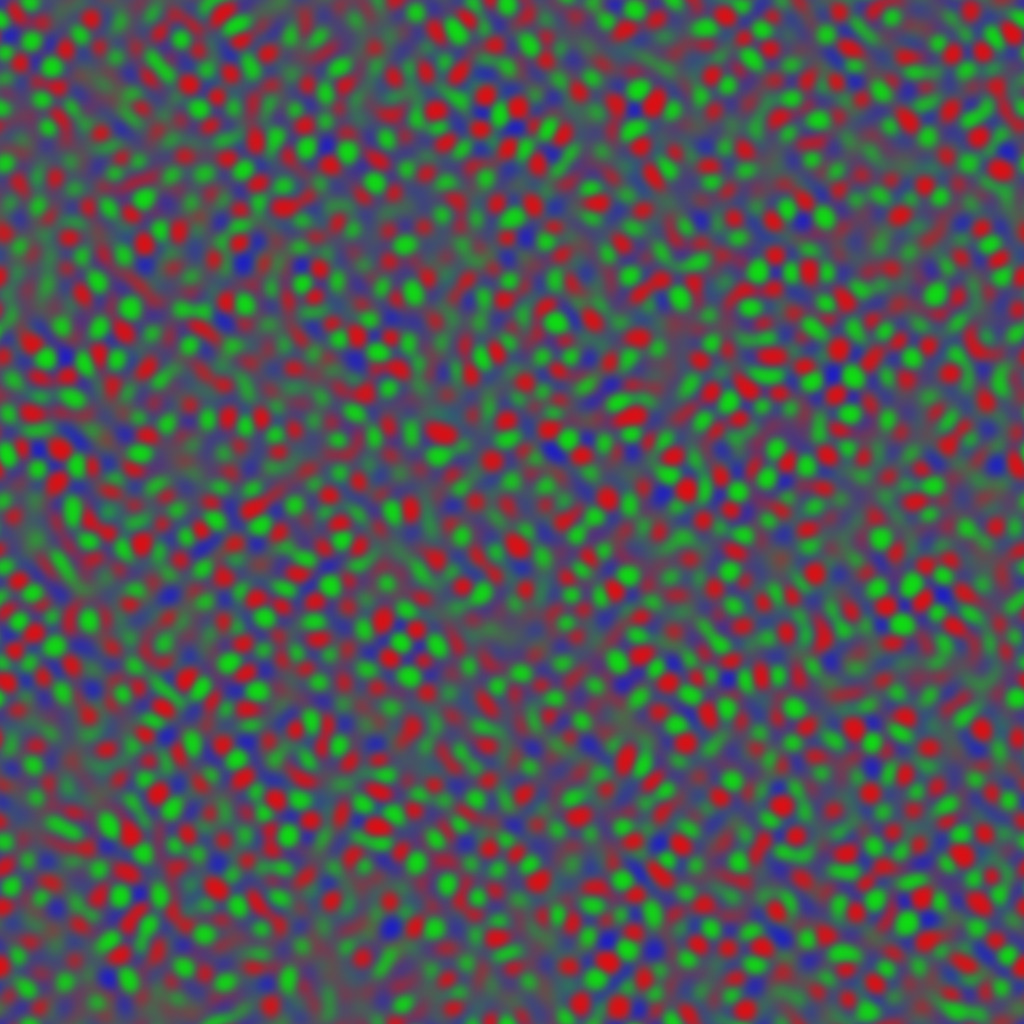
Red, green and blue domains aligned diagonally during ternary phase separation with elastic anisotropy, from Sandeep Sugathan’s thesis
Elasticity shapes
phase separation.
From the PhD thesis of Sandeep Sugathan (2019).
Meet the work behind the images ↓
Phase-field modeling✳Elastic stress effects✳Physics-informed neural networks✳High-performance computing
OUR STUDENTS · THEIR RESEARCH

Microstructures from
my students’ research.

These images come from the doctoral research of my students at IIT Hyderabad. Each pattern reflects a physical question, a mathematical model and the careful work of understanding the result.

SANDEEP SUGATHAN · PhD, 2019

Elastic stress effects in ternary alloys

See how elastic stresses affect phase arrangement and coarsening in a three-phase alloy.

Ternary alloy E1, diagonal alignment case, at dimensionless time 1000
t = 1,000
Ternary alloy E1, diagonal alignment case, at dimensionless time 2500
t = 2,500
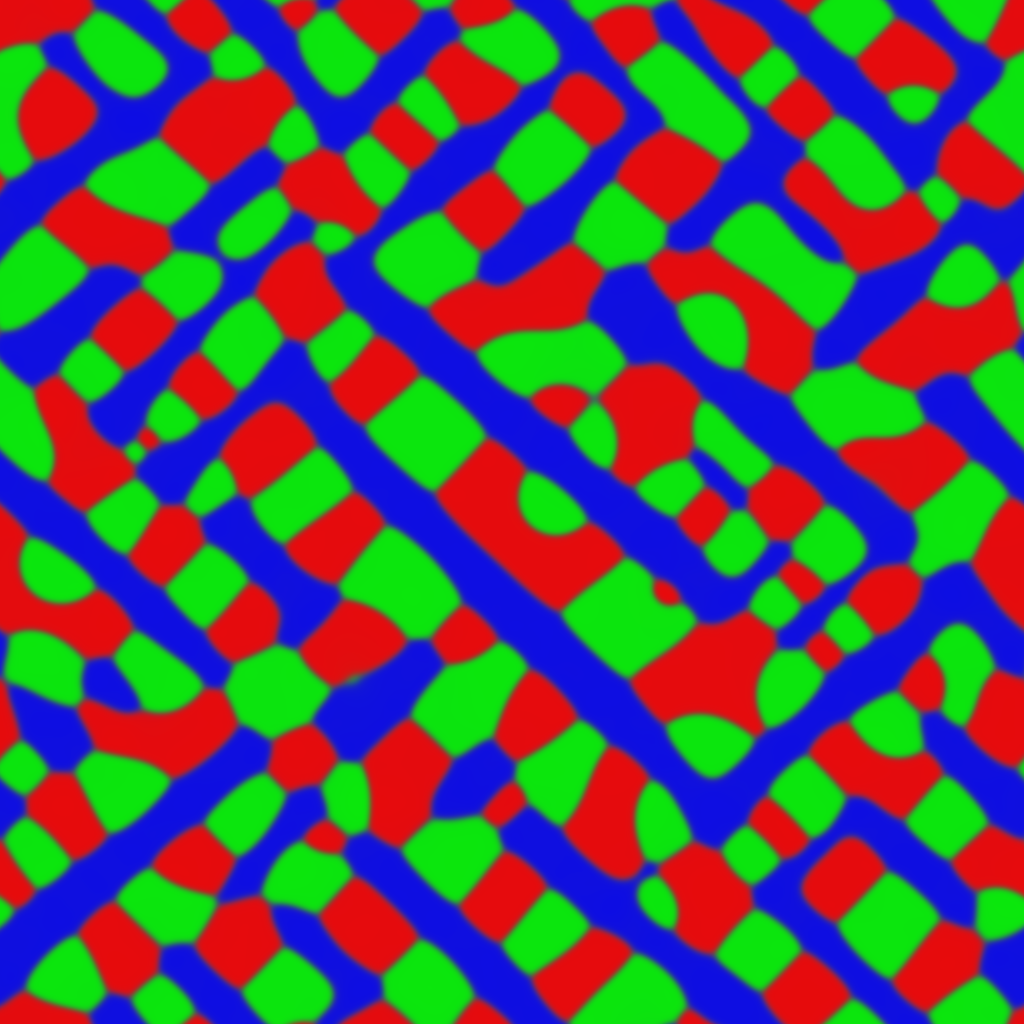
Ternary alloy E1, diagonal alignment case, at dimensionless time 20000
t = 20,000
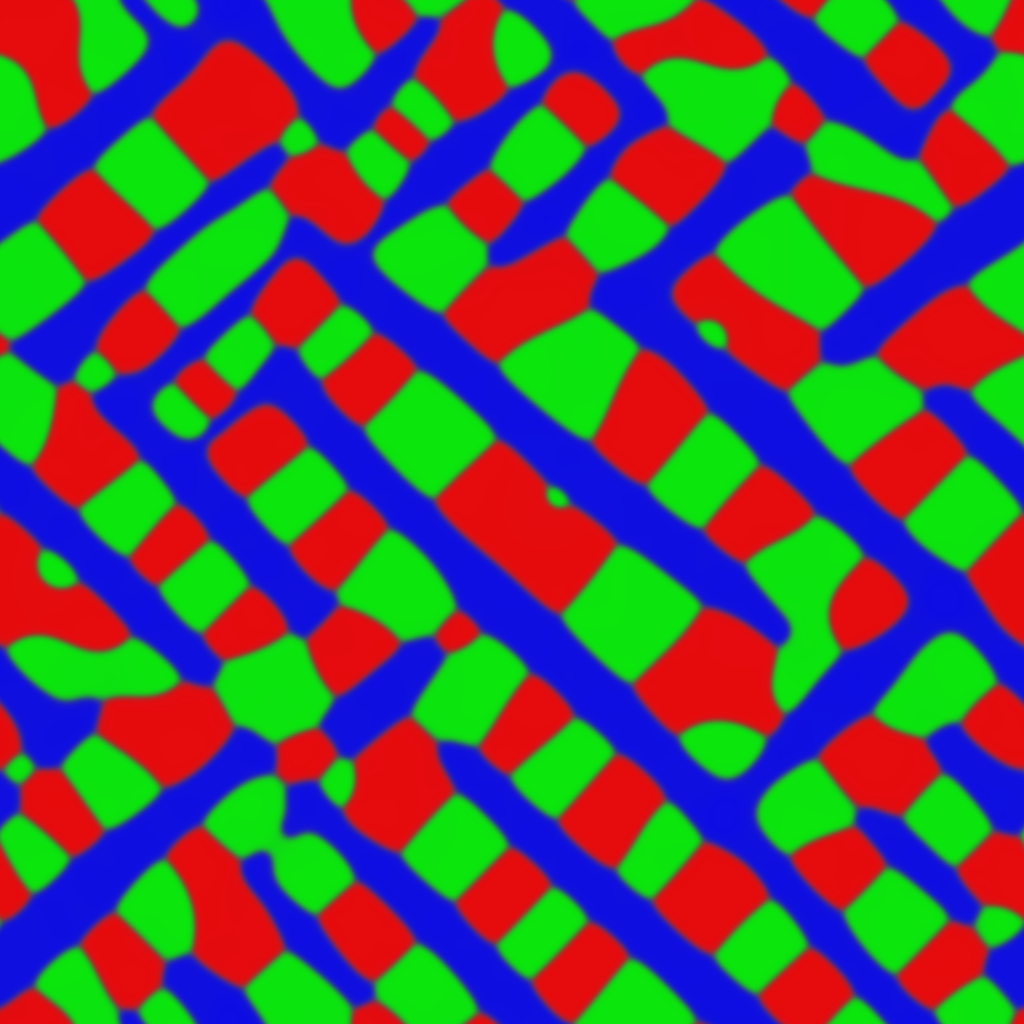
Ternary alloy E1, diagonal alignment case, at dimensionless time 35000
t = 35,000

Three-phase patterns evolve and coarsen under elastic anisotropy. The sequence shows alloy E₁⟨11⟩; time is dimensionless. The original RGB composition mapping is retained.

From the PhD thesis of Sandeep Sugathan (2019), A Phase-Field Study of Elastic Stress Effects on Phase Separation in Ternary Alloy Systems.

Explore elastic stress effects →
SOUMYA BANDYOPADHYAY · PhD, 2020

Ferroelectric domains in three dimensions

See how electrostrictive constraints reorganize three-dimensional ferroelectric domains.

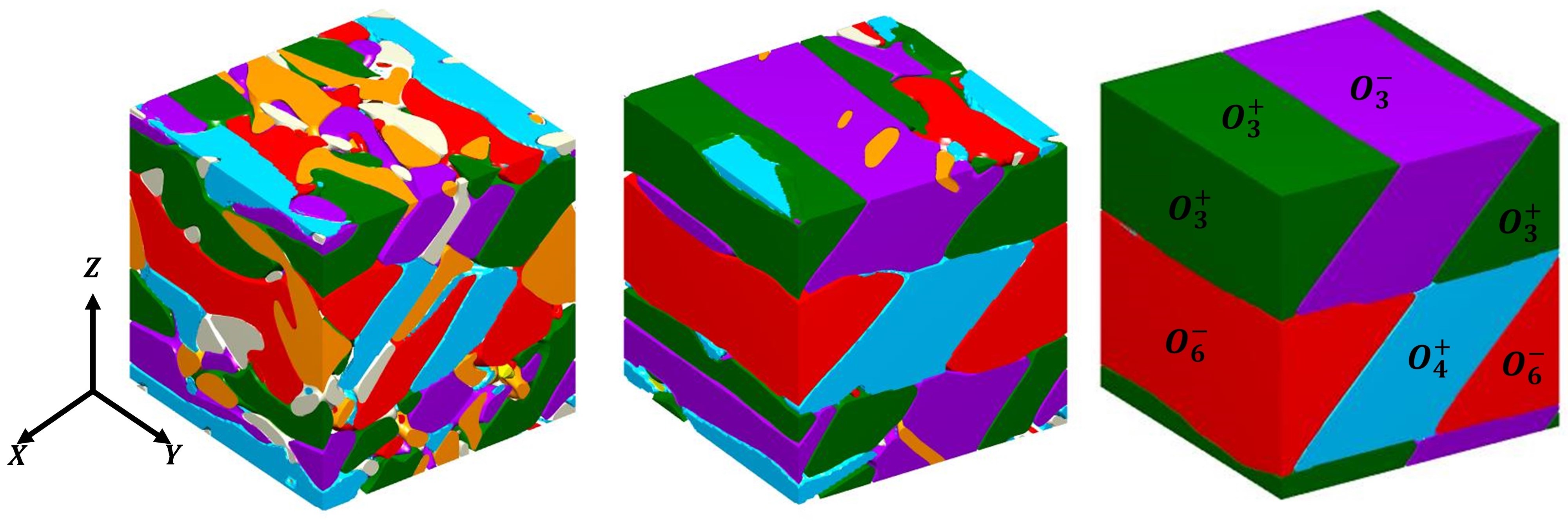
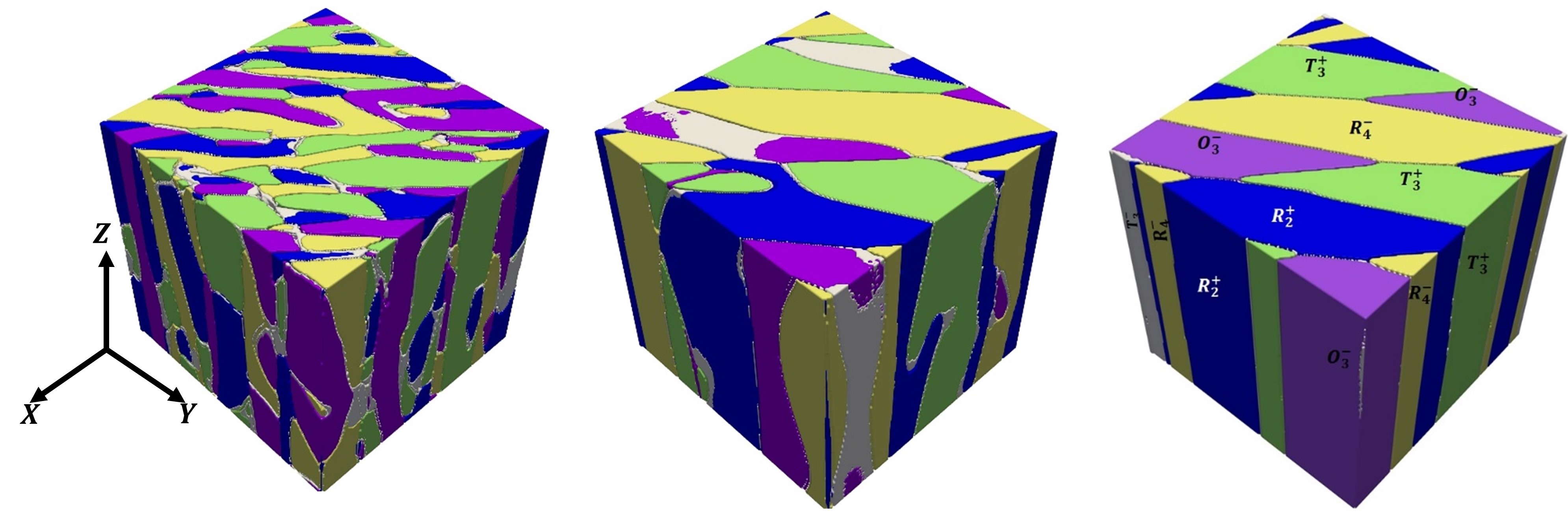
Three stages of orthorhombic ferroelectric domain evolution in equimolar BZCT, Case 1
Case 1 · electrostrictive anisotropy Qz = 1
Three stages of coexisting tetragonal, rhombohedral and orthorhombic domains in equimolar BZCT, Case 3
Case 3 · electrostrictive anisotropy Qz = 2.5
Original color key for orthorhombic, rhombohedral and tetragonal polarization variants

Room-temperature domain evolution in equimolar BZCT. In each row, time advances from left to right: 10,000 → 50,000 → 150,000 (dimensionless). Colors identify polarization variants; they do not show concentration. T, R and O denote tetragonal, rhombohedral and orthorhombic phases.

From the PhD thesis of Soumya Bandyopadhyay (2020), A Phase-Field Study of Electromechanical Effects on Domain Evolution and Polarization Switching in Bulk, Thin-Film and Multi-layer Ferroelectric Perovskite Oxides. Read the related paper ↗

Explore phase-field research →

Original scientific images extracted from the supplied theses; colors, proportions and embedded labels are preserved. Select an image to see it at its source resolution.

CμMS · THE PEOPLE BEHIND THE WORK

Computational Microstructures Group.

Modeling and simulation of microstructural evolution toward accelerated materials design.

Meet the CμMS Group ↗
Suman Sadhu
Suman
D. Atchyut Kumar
Atchyut
Pushkar Pandit
Pushkar
Deepak Sharma
Deepak
Falak Beig
Falak
Gaijinliu Gangmei
Gaijinliu
Ismail Kamil Worke
Ismail
Vaishnavi S. M.
Vaishnavi

The Computational Microstructures Group (CμMS) brings together phase-field modeling, elasticity, transport, inverse methods and scientific software. Visit the group site for people, projects, codes, preprints, posters and experiments in computational materials science.

ABOUT

Connecting processing,
microstructure and properties.

My research brings together phase transformations, elastic stress effects, micromechanics and physics-informed neural networks (PINNs). We develop physics-based models and computational tools for alloys and functional oxides, spanning microstructural evolution, diffusion and coupled mechanical effects.
My academic advisers: Prof. T. A. Abinandanan, my PhD adviser at IISc, and Prof. Long-Qing Chen, my postdoctoral research adviser at Penn State.

Academic background ↗
Saswata Bhattacharyya

Professor, IIT Hyderabad
Ph.D., Indian Institute of Science

My academic experience →
RESEARCH DIRECTIONS

From physical mechanisms
to predictive models.

All research areas ↗
FOR STUDENTS & RESEARCHERS

Mesoscale Microstructure
Modeling resources.

Use the equations in a calculation and examine the results. Explore a learning pathway, open-source solvers and a reproducible phase-field example.

Enter the resource library ↗
SELECTED WORK

Recent publications.

View selected publications ↗
THE FUN IN SCIENCE

The Fun
in Science.

My understanding, confusions, questions and discoveries. A space for photographs, exchanging ideas and discussing science.

Explore The Fun in Science →